
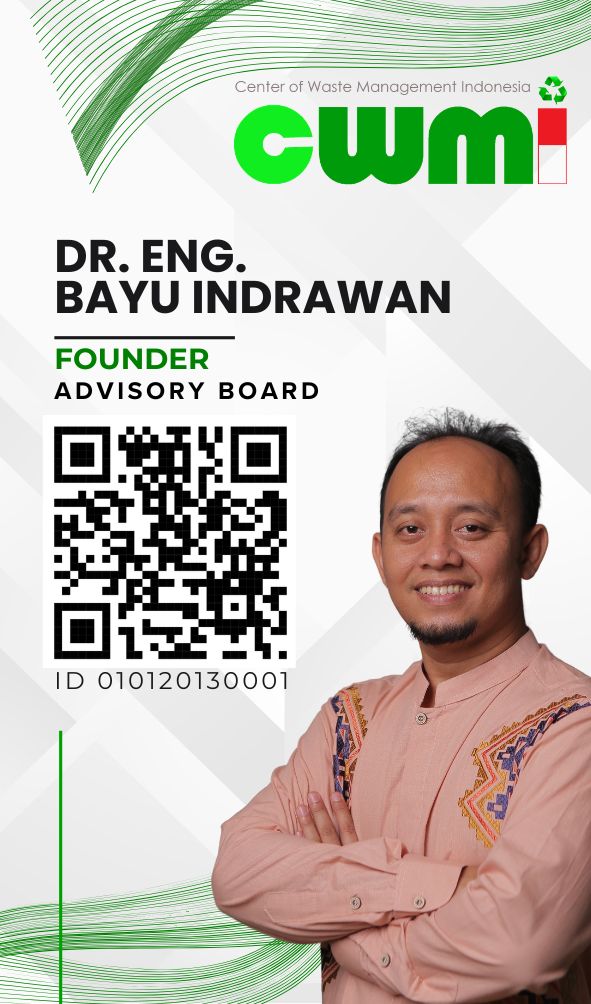
Dr. Eng. Bayu Indrawan is an environmental engineer, researcher, and technology innovator specializing in circular economy, integrated waste management, waste-to-energy (WtE), hydrothermal and pyrolysis technologies, smart waste systems, and environmental technology commercialization. He is the Founder and Advisory Board of the Center of Waste Management Indonesia (CWMI), an independent research and innovation organization dedicated to advancing sustainable waste management through science, engineering, digital innovation, and strategic partnerships.
With over a decade of experience spanning academia, research, government collaboration, and industry, Dr. Indrawan has established himself as a leading expert in developing innovative environmental technologies that bridge scientific research with real-world implementation. His work focuses on transforming waste into valuable resources while supporting the transition toward a circular economy and low-carbon development.
He earned his Doctor of Engineering (Dr. Eng.) in Environmental Science and Technology from the Institute of Science Tokyo (formerly Tokyo Institute of Technology), Japan, where his research focused on advanced waste treatment technologies, biomass utilization, thermochemical conversion, and sustainable environmental systems. He also holds a Master of Engineering from the University of Indonesia, specializing in environmental engineering and sustainable technology development.
Throughout his career, Dr. Indrawan has led multidisciplinary research and innovation projects in collaboration with universities, government agencies, industries, and international partners. His expertise covers the entire innovation value chain—from research and development to pilot implementation, commercialization, and policy support—ensuring that technological innovations create measurable environmental, economic, and social impact.
One of his major contributions has been pioneering the development and commercialization of hydrothermal and pyrolysis technologies for converting municipal solid waste, biomass, and agricultural residues into renewable fuels, biochar, and other value-added products. These initiatives represent some of the earliest commercial-scale applications of advanced thermochemical waste conversion technologies in Indonesia, demonstrating practical pathways toward sustainable waste management and renewable energy production.
Recognizing the importance of digital transformation in environmental management, Dr. Indrawan is also leading the development of AI-powered Smart Waste Ecosystems that integrate Smart Reverse Vending Machines (Smart RVM), Artificial Intelligence (AI), Computer Vision, Internet of Things (IoT), QRIS, digital payment systems, and cloud-based analytics. These innovations are designed to strengthen recycling systems, increase public participation, promote financial inclusion, and accelerate the implementation of circular economy principles through data-driven and technology-enabled solutions.
Beyond technology development, Dr. Indrawan actively serves as an advisor and collaborator for government institutions, universities, research organizations, industries, and international partners on sustainable waste management, waste-to-energy, environmental policy, ESG implementation, technology commercialization, and innovation ecosystem development.
As Founder and Advisory Board of CWMI, he provides strategic leadership in shaping the organization's long-term vision, research priorities, international collaborations, and innovation roadmap. Under his guidance, CWMI continues to foster multidisciplinary partnerships that connect science, engineering, business, and public policy to address complex environmental challenges.
His vision is to position CWMI as a leading center of excellence in circular economy, waste management innovation, waste-to-energy technologies, and smart environmental systems, contributing not only to Indonesia's sustainable development goals but also to regional and global environmental solutions.
Dr. Indrawan believes that solving future environmental challenges requires more than technological advancement. It demands strong collaboration among academia, government, industry, financial institutions, and communities to build integrated ecosystems that generate long-term environmental sustainability, economic resilience, and social prosperity.